
Building Your Strategy for Multi-Unit Franchise Ownership
Thinking about opening a second franchise location? Multi-unit ownership is an exciting step — but it requires a completely new approach to funding and management. Here's how to plan for it.
For many franchisees, the first location is just the beginning. Once your initial business is running smoothly and showing healthy profits, it’s natural to start thinking about what’s next. For an increasing number of franchisees, the next step means one thing: opening another site.
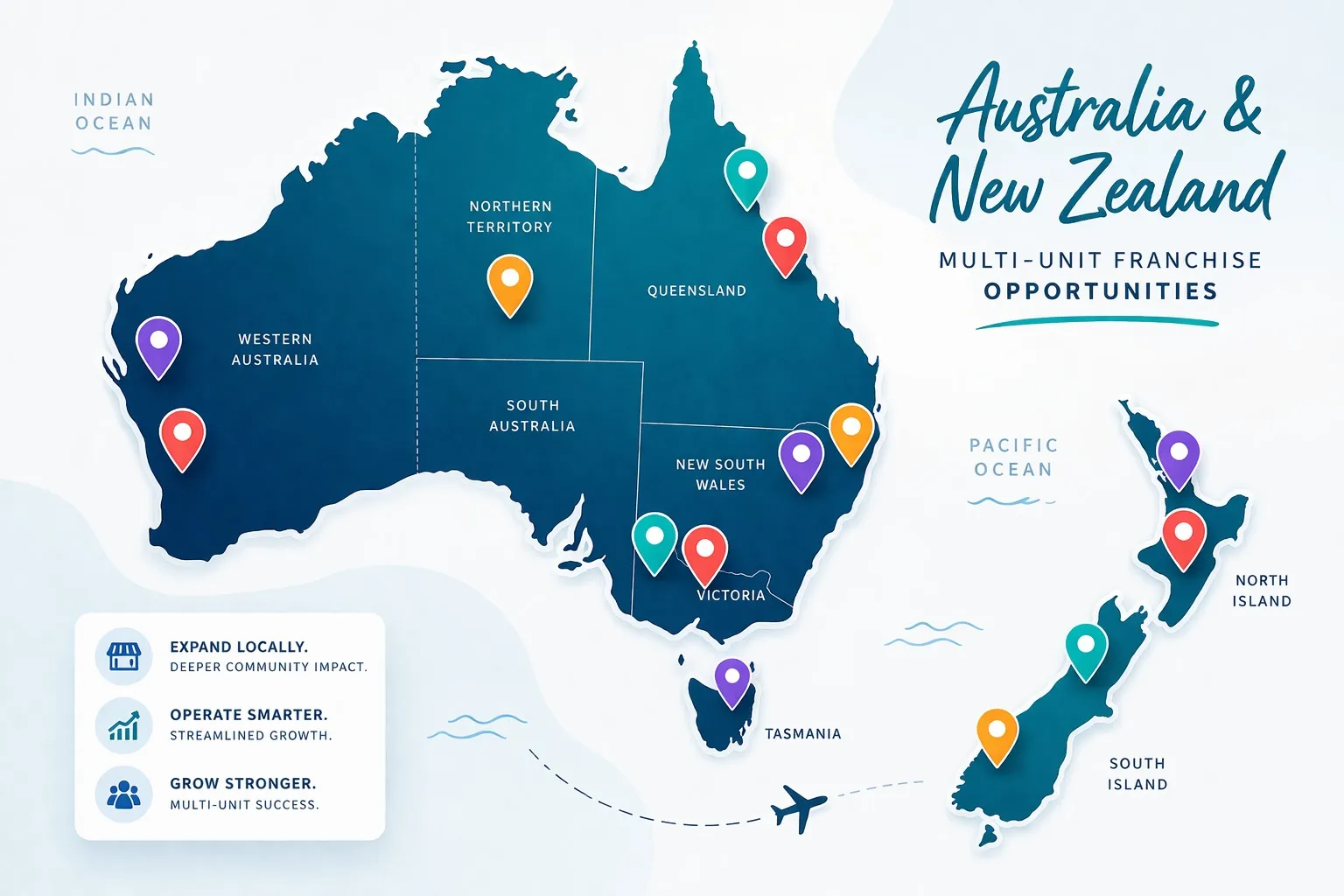
In highly developed franchise markets like the US, multi-unit franchisees account for more than half of all franchised units. That number is a little lower for Australia and New Zealand, but it’s climbing rapidly.
Expanding your franchise can be financially rewarding — but it’s a leap that requires careful planning, especially when it comes to finance. Scaling from one outlet to two or more isn’t just about duplicating your first success. It requires a completely new approach to how you fund and manage your business.
Why multi-unit ownership is a different game
Owning a single franchise often means you’re hands-on with day-to-day operations. You know your team and your customers, you have your finger on the pulse, and you’re across all your numbers. But when you open a second (or third) location, everything changes. Your time is stretched, responsibilities multiply, and the stakes get higher.
Financially, the jump can be significant. You’re not just repeating the costs of your first site — you’re also building infrastructure to support growth. At the very least you need someone to do what you do when you’re not there. As your empire grows, you’ll likely need centralised management, more complex accounting, and possibly a regional manager.
Your finance strategy needs to reflect this shift.
The capital challenge
Before you expand, you need to understand what it will cost. While figures vary depending on your industry, location, and brand, here are the major areas where you’ll need capital:
- Franchise fees — some franchisors offer discounts for second or third units, but others charge the full amount. Tip: it might be economical to secure multiple sites from the outset, or agree a “first right of refusal” for adjoining territories.
- Fit-out and equipment — even if you’ve done it before, every site has unique requirements. Fit-out can vary significantly based on site type, location, and even local government regulations.
- Staffing and training — hiring and onboarding a whole new team adds to upfront costs and is a big demand on your time (and your existing team’s).
- Inventory and working capital — stocking your new outlet and covering costs before revenue flows in.
- Marketing and local promotion — each location needs a strong launch.
It’s not just about securing funds to open — you need a financial buffer to cover the ramp-up period until the new site becomes profitable.
Key takeaway: Budget beyond the opening costs. A new location rarely hits full profitability from day one — having a financial buffer for the ramp-up period is what separates a smooth expansion from a stressful one.
Financing options for multi-unit franchisees
With a proven track record, lenders are more likely to view you as a lower-risk borrower. Here are the main types of finance to consider:
- Term loans — traditional business loans with fixed repayments. These work well if you have a clear cost breakdown and strong repayment ability.
- Cash flow lending — based on your existing business performance rather than physical assets. Often used for growth funding.
- Lines of credit — provide flexibility for covering short-term needs, especially during the opening phase.
- Equipment finance — useful for fit-outs, kitchen gear, vehicles, or point-of-sale systems.
- Multi-site lending facilities — some lenders offer packages that fund multiple locations under a single agreement, or it might make more sense to keep one facility per site.
The right mix often includes both long-term funding for capital expenses and shorter-term solutions to manage operating cash flow.
Preparing a compelling finance case
To access funding, you’ll need to present a strong business case. The more professional and data-backed your approach, the more confidence you’ll inspire.
- Track record — performance data from your existing franchise. Consistent profitability is key.
- Experience and capacity — do you have the time and skills to manage multiple locations? Will you be hiring a site manager? Can you travel easily between sites?
- Growth plan — a detailed, realistic plan for how the new unit will be rolled out, staffed, and marketed.
- Financial projections — show expected revenue, expenses, and cash flow for each site. It can help to show consolidated figures if the new site can’t stand on its own immediately.
- Contingencies — what happens if things go wrong? Lenders want to see you’ve considered the risks (even if you don’t have an answer for everything).
Working with a lender that specialises in franchising can offer huge benefits when it comes to expansion.
Tip: A specialist franchise lender already understands your model, your brand, and the economics of multi-unit growth. That means less time explaining your business and more time focused on getting the right structure in place.
Managing risk as you scale
The jump to multi-unit ownership should be a calculated progression, not rushed. One of your biggest risks is overextending yourself — whether personally or financially.
Be clear on how much work you can handle and how much debt your businesses can support. Keep a close eye on how you’re tracking against your budget to avoid unexpected cash shortfalls.
Remember: when it comes to borrowing, rushed can often mean expensive.
Some practical risk management steps:
- Stagger openings — avoid launching multiple locations simultaneously. Spread the risk and ensure you can focus on everything that needs attention.
- Be strategic about locations — choose areas with different customer bases or economic drivers, or cluster your businesses geographically for efficiency.
- Build operational support — invest in systems and people that let you focus on strategy rather than day-to-day operations.
- Insure adequately — consider key person insurance, business interruption cover, and income protection.
The cash flow factor
One of the trickiest parts of owning multiple franchises is managing cash flow across locations. You might have one unit generating healthy profits while another is still finding its feet. That’s why you need a consolidated cash flow forecast that looks at the entire group — not just individual stores.
Plan for seasonal variations, delayed payments, and overlapping costs. Use software or financial advisors who can help you model scenarios and prepare for cash squeezes.
Think long-term: your exit strategy
It might seem odd to talk about exit strategies while planning to grow, but your finance plan should consider how you’ll eventually step away or sell. Whether you aim to pass the business to a family member, sell to a private investor, or pursue another path, you’ll want clean financials and manageable debt structures.
Your thoughts on how your empire might eventually contract — or how you might exit — can also help determine the right structure for your business (one big company vs several smaller ones).
Final thoughts
Scaling to multi-unit ownership is a powerful way to build wealth — but without a robust finance strategy, it can quickly become overwhelming.
With careful planning, good advice, and the right funding, you can make the leap with confidence — and perhaps sooner than you might have thought.
The bottom line: Multi-unit franchise ownership is a powerful wealth-building strategy, but it demands a step up in planning, funding, and operational discipline. Careful preparation and the right finance partner make all the difference between scaling successfully and stretching too thin.
Need help with your next step?
Talk to a CFI Finance Specialist — no obligation, just practical advice.